


-
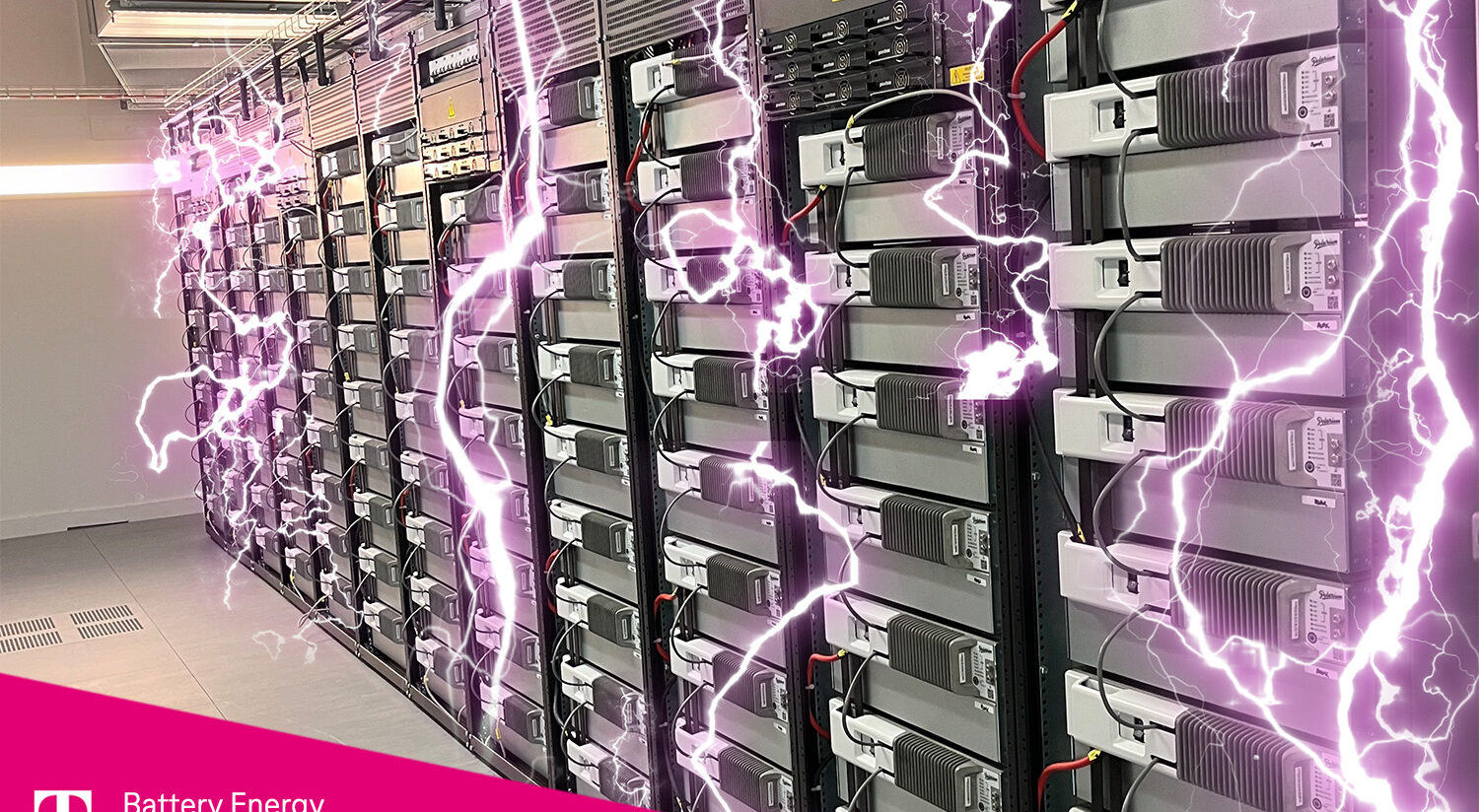
Premiere in Münster: Telekom, via its subsidiary PASM, is the first telco worldwide to deploy large-scale battery storage systems for renewable energy.
-
Expansion planned: Additional storage sites are being built in Hanover, Bamberg and Munich.
-
Long-term PPA with EnBW: PASM will source 100 MW in the future from a German offshore wind farm.
Deutsche Telekom plans to become climate-neutral by 2040. As Power and Air Condition Solution Management GmbH (PASM), we have commissioned the first large-scale battery storage systems for integrating renewable energy. This makes the company a pioneer in the telecommunications industry and an active contributor to Germany’s energy transition.
Green power supply through large-scale battery storage systems
Large-scale battery storage systems are used to store surplus wind and solar energy and feed it back into the grid when needed. They help keep the power supply stable, balance grid fluctuations, and make it easier to integrate renewable energy into the electricity grid. Since renewable energy is not always available continuously, a successful energy transition is not possible without storage technology.
Together with partner companies INTILION and Pixii, PASM integrated the first two large-scale battery storage systems in Münster into the power grid on April 24, 2024, each with a capacity of 6 megawatt hours (MWh) per battery system. This makes Deutsche Telekom the first telecommunications company to operate large-scale battery storage for sustainable energy.
Münster’s Mayor Markus Lewe emphasized the importance of the new storage systems for the city: “The collaboration with Telekom and its subsidiary PASM is a great example of successful partnerships in the field of renewable energy,” said Lewe. “I’m pleased that Münster is increasingly becoming a hotspot for storage technologies and battery research, which are essential for the energy transition.”
PASM is also building three additional storage sites in Hanover, Bamberg and Munich, bringing total capacity to 66 megawatt hours (MWh). By 2030, Telekom and PASM aim to store a total of 300 MWh of energy. “With our large-scale battery storage systems, we can further increase our share of renewable energy and actively shape the energy transition,” emphasized Bernd Schulte-Sprenger, Managing Director of PASM.
Abdu Mudesir, Managing Director Technology at Telekom Deutschland, said: “Being the first telecommunications company to rely on large-scale storage systems—especially in network operations—underscores our ambition to be not only a quality leader, but also an innovation leader. This technology, combined with economic viability, makes an important contribution to Telekom’s ambitious plans to become climate-neutral by 2040 and ensures that we are making our network sustainable and future-proof.”
A further path to more sustainable electricity
PASM is continually expanding its renewable energy portfolio through Power Purchase Agreements (PPAs). From January 2026, Deutsche Telekom will source 50% of its energy portfolio via PPAs. Through the recently concluded long-term power purchase agreement with EnBW, it will in future receive 100 MW from the “He Dreiht” wind farm in the German North Sea. Partnerships like these make a significant contribution to the rapid expansion of renewable energy and show how consistently Telekom is pursuing its goal of becoming climate-neutral by 2040.
About Deutsche Telekom: Deutsche Telekom Group profile

